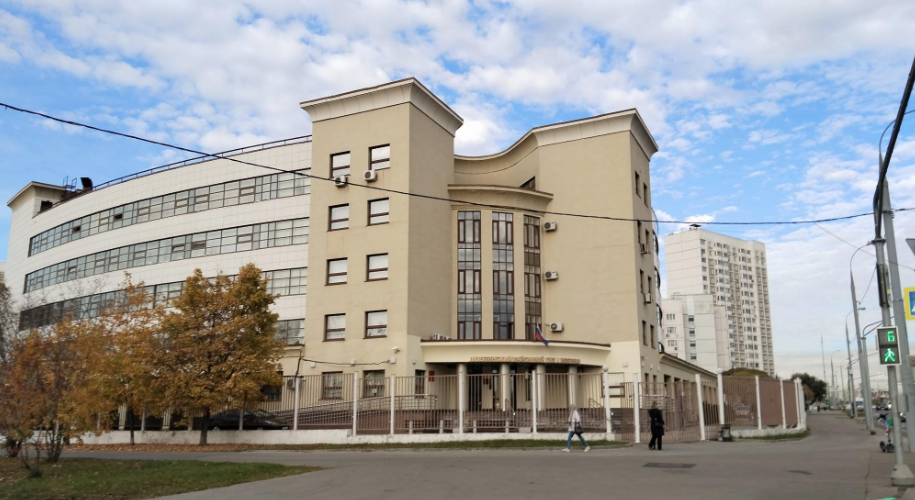
About the case: Yulia Baytyul, who is being held in SIZO-6 (pre-trial detention facility) in Moscow (Pechatniki), has filed an administrative lawsuit against the facility. She considers unlawful the refusal by the head of the SIZO (pre-trial detention facility) to send her to a civilian hospital for a medical examination. The court of first instance dismissed the claims.
The case is being heard by the Lyublinsky District Court of Moscow, with Judge Anastasia Igorevna Sabirova presiding.
Participating are the plaintiff (Yulia Ivanovna Baytyul), her representative, lawyer Bakhor, and the defendant’s representative, Selezneva.
The plaintiff’s side moves for the production of evidence: Baytyul’s medical records (her medical file, prescription sheets, and test results), which are held by the defendant. Baytyul has given her consent to the disclosure of her medical information.
The judge asks why all of this is needed. The plaintiff’s representative replies that the facility refuses to release these documents despite repeated requests. They are needed to understand Baytyul’s state of health and to prove that she has a disease included in the list of diseases that preclude detention in a SIZO.
The representative of SIZO-6 objects, stating that this is not within the remit of the head of the SIZO and that the documents must be issued by Medical and Sanitary Unit No. 77 (MSCh-77).
The court denies the motion, since the medical records are not the subject of the dispute.
Baytyul’s representative points out that the refusal now being challenged was based precisely on these medical records. She moves to join as administrative defendants the Medical and Sanitary Unit of the Federal Penitentiary Service of Russia, the Main Directorate of the Federal Penitentiary Service (GUFSIN) for Moscow, and MSCh-77.
The SIZO representative replies that GUFSIN is a supervisory body and has nothing to do with the case, and that MSCh-77 likewise has no connection to the case at present.
The court defers ruling on this motion as premature.
The administrative defendant moves to add to the case file a medical certificate dated October 1, 2026, which does not list any diagnoses. The plaintiff does not object; the certificate is admitted.
The case is presented.
Baytyul has asked the court to declare unlawful the response of the head of SIZO-6 dated April 2, 2026, in which he refused her a medical examination. Baytyul suffers from a serious illness included in the government’s list (one that precludes detention in a SIZO).
The plaintiff’s representative, Bakhor, supports the claim and asks the court to grant it.
The defendant’s representative disagrees. She argues that the refusal has a legal basis, was issued within the time limit established by law, and that the deviation from the required form is insignificant.
The response took the form of a letter rather than a resolution, as required, but this cannot be grounds for declaring it unlawful, since it does not affect the outcome. The violation has now been remedied: a resolution has been issued, sent to the defense lawyers, and handed to Baytyul herself.
The legal basis for the refusal is that the documents received from Lithuania (where the accused had worked) contain no discharge summary; they are outpatient rather than inpatient records, and there is no information about hospitalization.
In the defendant’s view, the medical examination can be carried out through the SIZO medical unit without hospitalization in a civilian hospital. Alternatively, she could be taken to the medical unit at Matrosskaya Tishina, or doctors from state hospitals could be invited to the SIZO. Baytyul receives medical care in SIZO-6. In her objections, the defendant’s representative referred to “the rules” without specifying which “rules” she meant.
The defendant asks the court to dismiss the claims.
The plaintiff disputes that she receives proper medical care in the SIZO: “That’s not true. For a year and a half I’ve been going to her [the doctor — ed.] every Wednesday. You have to howl in pain for 2 months before they give you a doctor”.
The court returns to the motion to join co-defendants and denies it.
The court reads out the case materials, including several certificates stating that Baytyul’s condition is satisfactory.
The plaintiff’s representative moves for an adjournment to prepare for closing arguments. The judge replies that the Code of Administrative Procedure does not provide for time to prepare for closing arguments.
The plaintiff’s representative then asks simply to adjourn the hearing; the court refuses, as there are no grounds for doing so.
The court proceeds to closing arguments.
The plaintiff’s representative, lawyer Bakhor, says the claim must be granted, since Baytyul’s condition will worsen and may lead to irreversible consequences. No medical examination is being carried out in the SIZO; she has not been seen by a trauma specialist or an oncologist (she has a benign breast tumor). The defendant points to an alternative route through the medical unit, even though the answer there will be the same. In the view of the plaintiff’s representative, this amounts to the SIZO evading its obligations.
The administrative defendant declines to take part in the closing arguments.
The court dismisses the claims.