About the case: Police Lieutenant Ilya Vyacheslavovich Yakutin, a traffic police (DPS) officer, is charged with exceeding his official powers with the use of torture, resulting in grave bodily harm (Part 5 of Article 286 of the Criminal Code of the Russian Federation). According to the investigation, he was pursuing a car that had refused to stop when signaled by the police. When the car was finally stopped in a courtyard, Yakutin pulled two passengers out of it (neither of whom was the driver) and beat them. One of the victims was hospitalized in serious condition.
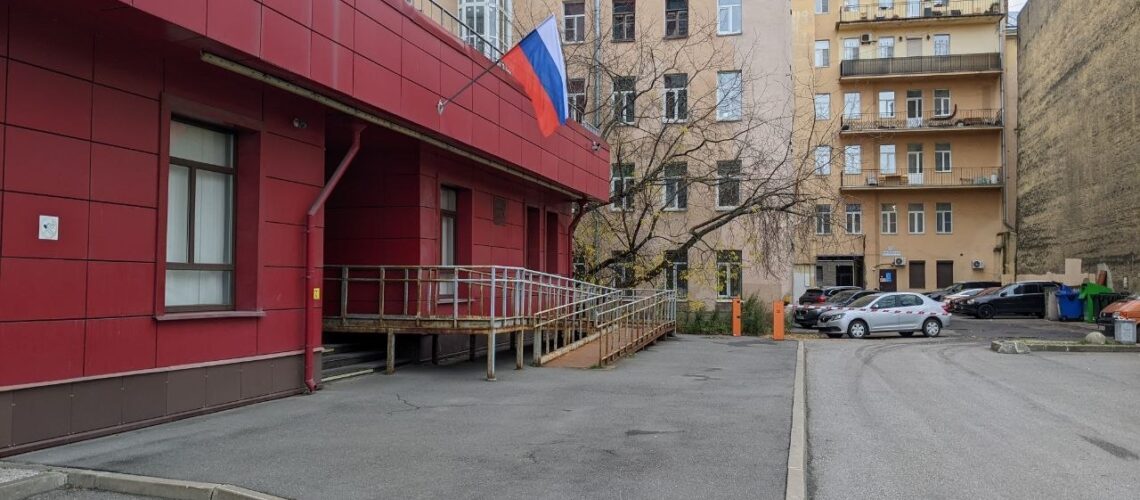
The case is being heard by the Frunzensky district court of St. Petersburg, with Judge Roman Aleksandrovich Chebotarev presiding.
Taking part are Yakutin, his defense counsel (lawyer Palshkov), Chezhia, assistant prosecutor of the Frunzensky District of St. Petersburg, the victims Stepanov and Krasnov, and Krasnov’s representative (lawyer Gerasimov). Before the hearing began, Yakutin’s defense counsel and the victim’s representative were called into the courtroom one after the other for a few minutes; they then came back out and continued waiting in the corridor until all the parties were invited in. Following this conversation, the lawyer told Yakutin that the judge wished to examine his wife as a witness (“he needs your wife after all”), then phoned her himself and asked her to come to court to give a character reference for the defendant.
The court establishes Yakutin’s identity “as a check”, including his full name, date and year of birth (born 1982), education (higher), marital status (married with an adult daughter), the fact that he is currently retired, and the absence of a criminal record.
Lawyer Gerasimov passes on a request from the absent representative of the victim Stepanov (lawyer Tereshchenko) for the case to be heard on October 26, 2026, without him, as he is “unable to attend in person”.
The request is discussed. Stepanov confirms that his representative’s absence was agreed with him. There are no objections, and the hearing continues with those present.
The state prosecutor makes an oral motion to extend Yakutin’s preventive measure (house arrest) by 3 months, since the case cannot be heard before October 30, 2026, and the grounds on which the measure was imposed have neither changed nor ceased to exist.
The victims’ side supports the motion, and the others do not object. The court retires to the deliberation room to make a decision and, on its return, announces that the motion is granted.
The state prosecutor then moves for the testimony of the absent witness Olenichenko to be read out (he was the driver of the car that failed to stop when signaled by Yakutin and in which the victims were riding). He was duly notified by the prosecutor’s office, and “he submitted a recording in which he said he is aware of these circumstances”.
In the absence of objections, the motion is granted, and the prosecutor reads out the case materials.
Record of the examination of the witness Stanislav Andreevich Olenichenko:
He works as a courier. On December 11, 2025, he was sitting in his car with his friend Evgeny when, at about 12:30 a.m., two men he did not know (Stepanov and Krasnov) came up and offered him a thousand rubles to drive them to the Prospekt Slavy metro station. The witness agreed, and Evgeny got out of the car, “maybe he had his own plans”. They all got into the car and drove off in that direction. “While making a U-turn at the roundabout, I, being at the wheel, ran a red light because I wanted to drop off the passengers quickly and finish the trip”… “Shortly before that I had drunk alcohol, but I can no longer say how much”.
A traffic police car with its flashing lights and siren on began approaching from the left, and the officers ordered him over the loudspeaker to stop. “Being in a state of shock and panic, and fearing liability for the traffic violation I had committed, I, without realizing what I was doing, sharply accelerated and again drove through the intersection on a red light, moving away from the officers”. The officers continued the pursuit, and the passengers asked him to stop.
Trying to get away, he turned into the courtyards of residential buildings, where he ended up in a dead end. As soon as he stopped, a police officer ran up, opened the driver’s door, pulled him out onto the ground by his jacket, put him face down, handcuffed him, and pinned him to the ground with his body. “Lying face down, in handcuffs, I heard the sounds of an argument and indistinct shouts nearby, but I did not see what was happening and did not hear the sound of blows, so I cannot say that anyone was beating anyone, because I was in a depressed state and quite frightened by the situation”. Then the officer who had restrained him lifted him up and took him to the traffic police car, while the second officer was talking to the passengers about something. “One of the passengers (Krasnov) had half his face smashed and covered in blood; I even got the impression that he had been dragged face first along the asphalt”. After a while the passengers were released and left. The police officers, who introduced themselves as Misikov and Yakutin, drew up an administrative detention report on him.
The court proceeds to examine the defense evidence.
The defendant is examined. Yakutin gives his testimony in free form, reading from a sheet of paper lying on the stand.
The victim’s representative (lawyer Gerasimov) has no questions, nor do the victims themselves. In response to questions from the court and the state prosecutor, Yakutin confirms that he agrees with the circumstances of the crime as charged, the indictment, all the testimony, the expert reports, and the other case materials. The judge is also interested in the defendant’s family situation, including his role in the life of his retired parents (“you help them, yes?”).
Although he declares full agreement with the charges, when answering more specific questions Yakutin’s position became contradictory and in effect amounted to only a partial admission of guilt: it emerged that he denies the classification of the crime as involving torture, admitting only that he exceeded his official powers and used violence.
Yakutin’s testimony:
On December 10, 2025, he went on duty with senior traffic police inspector Misikov. At about 1:30 a.m. they noticed a car make a dangerous maneuver at the intersection of Bukharestskaya Street and Slavy Avenue, pulled up alongside it, and turned on their flashing lights. Using a loudspeaker, he ordered the driver to stop for a document check, but the driver accelerated and drove forward against a red light. They pursued the car; the driver ignored repeated orders and turned into the courtyards. The chase lasted 1–2 minutes. The car drove into a dead end and stopped. His partner pulled the driver out of the car and detained him, knocking him to the ground and handcuffing him.
10–15 seconds later, Yakutin ran up to the passenger door shouting “Down, police!”, pulled Krasnov out of the car, and ordered him to stay where he was and lie on the ground. “In doing so I struck him several times because Krasnov tried to get up… several kicks (right foot, left foot) to the head, face, and torso, I don’t remember the exact number”. Going to the other door, he pulled out the second passenger (Stepanov), knocked him to the ground, and “ordered” him to lie down. “Stepanov started saying that they had nothing to do with it and didn’t know this driver, to which I replied that we would sort everything out… I also kicked him about 3 times in the torso and head”. His partner shouted “Ilya!”, and the defendant noticed Krasnov getting up and quickly went over to him. “Everything happened very quickly: when I came up to Krasnov, he had already got up, said something, had his back to me, and made what looked like a movement with his hand toward his groin… I reacted to this by sweeping his legs, kicking the lower part of Krasnov’s foot with my left foot, after which he fell to the ground, apparently hitting his head without managing to put his hands out… the driver and the passengers were all drunk”.
They called for an additional patrol unit, which arrived within 5 minutes, and during that time the defendant talked with the victims. “I realized that they really had nothing to do with it, that they really had ended up in that car by chance… I apologized to Krasnov and Stepanov… explained to them that we had assumed we were dealing with criminals, since they had been fleeing… the men said they had acted foolishly themselves by getting into a car with an unknown drunk driver… everyone understood, and at that point we had no grievances against each other”. During the conversation he noticed blood on Krasnov’s face and offered him a napkin; they then shook hands and went their separate ways. The victims were not taken to the police station, and administrative proceedings were initiated against the driver.
“In this situation, I realize that I should not have used violence against Stepanov and Krasnov, because as a result of my actions Krasnov suffered grave harm to his health… I admit that I exceeded my official powers, used violence against the detainees, and caused harm to the victims’ health… for which I sincerely repent, and I once again apologize to both Artem and Aleksandr. I voluntarily paid the victims monetary compensation totaling 150,000 rubles”.
In conclusion he adds that his daughter is studying at university, with annual tuition fees of 300,000 rubles, and that he has loan obligations and a joint mortgage with his wife, with a monthly payment of 17,000 rubles. His only source of income at present is his pension; his wife does not work (she is a homemaker) and looks after their daughter. He also supports his retired parents.
The presiding judge asks how the victims regard Yakutin’s apology; Krasnov and Stepanov confirm that they accept it.
The judge also asks how they regard the money received from Yakutin (50,000 rubles to Stepanov and 100,000 rubles to Krasnov). The representative (lawyer Gerasimov) considers it voluntary partial compensation for moral damage; further claims will be filed in civil proceedings after the verdict enters into force. The victims confirm this.
Lawyer Palshkov asks for Yakutin’s wife to be examined. The request is effectively granted without being formally considered or discussed with the parties, and the witness is immediately invited into the courtroom on the presiding judge’s instructions.
Irina Olegovna Yakutina, born 1984, the defendant’s wife, is examined as a witness.
She has known Yakutin since school (since the age of 14), and they have been married since 2007. She gives him a positive character reference: calm, non-confrontational, very responsible, gentle, cares for his elderly parents, and has always been very responsible about his work. “When our daughter was little, I asked him to quit, and he said it was his calling, it was what gave his life meaning”.
At lawyer Palshkov’s request and in the absence of objections, a number of character documents are added to the case file and then read out by the defense counsel:
– a shared equity construction agreement, a loan agreement, and a schedule of monthly payments;
– a contract for paid educational services between the university’s vice-rector and Yakutin for his daughter’s education;
– his mother’s pension certificate; a certificate confirming that Yakutin’s father has a Group III disability.
Also at the defense counsel’s request and in the absence of objections, the parts of the case file containing character information about the defendant are examined further:
– a certificate of Yakutin’s employment record: 2002, trainee driver in the militia battalion of the Private Security Department (OVO) of the Internal Affairs Directorate for the Frunzensky District of St. Petersburg; 2005–2011, driver in the militia battalion; 2012, police driver, senior police officer in the rapid response group of the police company of the OVO of the Directorate of the Ministry of Internal Affairs of Russia for the Frunzensky District of St. Petersburg; 2013–2015, police officer in a separate police company (of the same agency); 2015–2024, inspector of Platoon No. 2 of the Separate Traffic Police Company of the GIBDD (State Traffic Safety Inspectorate) of the Directorate of the Ministry of Internal Affairs of Russia for the Frunzensky District of St. Petersburg; “actual length of service in the Ministry of Internal Affairs: 2002–2024”;
– the investigator’s instruction to the acting head of the Internal Security Directorate of the Main Directorate of the Ministry of Internal Affairs of Russia for St. Petersburg and the Leningrad Region “to carry out operational-search measures to identify appeals and complaints concerning Yakutin”;
– the reply of the deputy head of the Internal Security Directorate of the Main Directorate of the Ministry of Internal Affairs of Russia for St. Petersburg and the Leningrad Region dated March 25, 2026: the checks established that no appeals or complaints about any unlawful actions by Yakutin had been received, and the directorate has no compromising information.
The court proceeds to closing arguments, in which only the state prosecutor, the defense counsel, and the representative take part.
The state prosecutor states that the investigators wrongly classified the defendant’s actions under Part 5 of Article 286 of the Criminal Code (“sufficient confirmation of the aggravating element was not found”) and asks for them to be reclassified under Paragraph “a” of Part 3 of Article 286 and Part 1 of Article 111 of the Criminal Code.
In the closing arguments, the prosecutor reads out the record of the on-site verification of Yakutin’s testimony in more detail than before. Yakutin confirmed that he “did not introduce himself to Krasnov and Stepanov, did not show his ID, and did not give them the opportunity to get out of the car voluntarily, thereby not giving them time to comply voluntarily with lawful demands”.
The prosecutor lists information about Yakutin’s personal circumstances, including that he is married, has no minor children, supports his daughter, who is in fee-paying education, has served in the Ministry of Internal Affairs since 2002, and has paid compensation to the victims.
There are no aggravating circumstances. As mitigating circumstances, the prosecutor asks the court to take into account his admission of guilt, remorse for what he did, and voluntary compensation for moral damage to the victims.
The prosecutor asks the court to find Yakutin guilty and impose the following sentence: under Part 1 of Article 111 of the Criminal Code, 3 years’ imprisonment; under Paragraph “a” of Part 3 of Article 286 of the Criminal Code, 4 years’ imprisonment and a 2-year ban on holding positions in Russian state bodies involving the functions of a representative of authority. The final sentence requested is 5 years in a general-regime penal colony and a 2-year ban on holding positions in Russian state bodies involving the functions of a representative of authority.
The judge notes that the state prosecutor has moved to less serious articles.
No one needs further time to familiarize themselves with the charges, everyone is ready to continue, and the court returns to the closing arguments.
The victims and the defendant decline to take part in the closing arguments, leaving it to the defense counsel and the representative to speak on their behalf.
Krasnov’s representative, lawyer Gerasimov, speaks next. He fully endorses the state prosecutor’s position, including the proposed classification and sentence, and asks for the same scope and length of punishment. In sentencing, he asks the court to pay particular attention to the irreversible harm the defendant caused Krasnov: “My client suffered grave harm to his health and is effectively blind in one eye… there’s no getting away from it, the man will have to live with it for the rest of his life, we ask that this circumstance be taken into account”.
Lawyer Palshkov (Yakutin’s defense counsel) emphasizes that Yakutin’s earlier admission of guilt fully covers the new version of the charges, so Yakutin fully admits his guilt.
He asks the court to take into account the following mitigating circumstances: remorse for what he did, active assistance in solving and investigating the crime, voluntary compensation for the damage, long service in the Ministry of Internal Affairs, and various awards and certificates of merit.
He asks for the sentence to be imposed taking into account Article 64 of the Criminal Code (imposing a more lenient sentence than that provided for the crime) and Article 73 of the Criminal Code (suspended sentence).
Yakutin gives his final statement:
“Once again I sincerely apologize to Artem and Aleksandr for everything that happened, for the harm caused to their health, especially to Artem, that it turned out this way. And, Your Honor, I ask you to take all the circumstances into account when sentencing me and to punish me as leniently as possible”.
The court retires to the deliberation room to reach a verdict.

© 2019-2026 Independent public portal on impartial trial monitoring
Подпишитесь на рассылку, чтобы ничего не пропустить