About the case: Egor Igorevich Semenov (the inmate) and Tatyana Ivanovna Semenova (his mother) filed a lawsuit seeking compensation for material and moral damage caused by the actions of the administration of SIZO-3 (Pre-Trial Detention Center No. 3) for the Rostov Region (the town of Novocherkassk). Semenov, who is being held in SIZO-3, did not receive a parcel sent by his mother, even though the parcel had been collected from the post office. The plaintiffs therefore believe that a SIZO employee may have appropriated it.
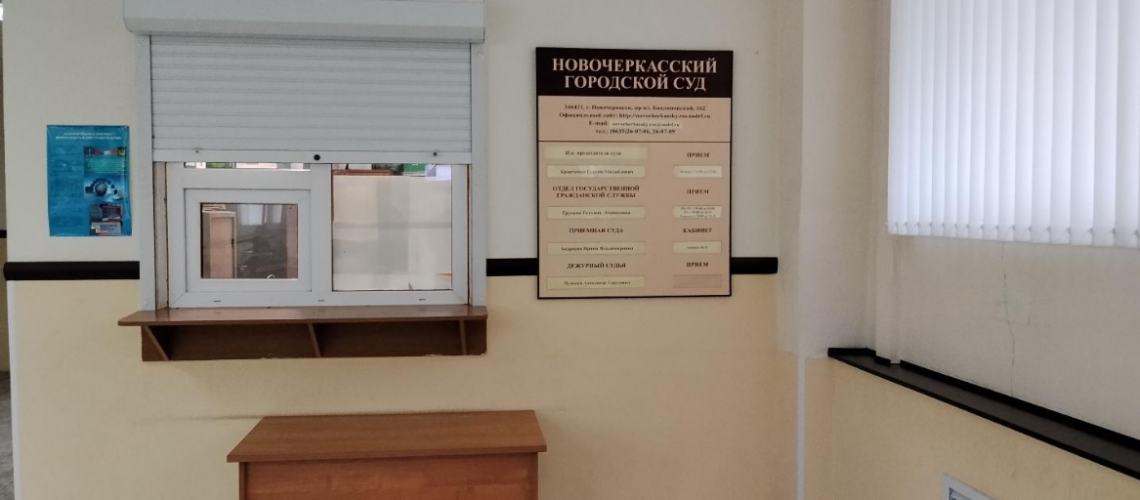
The case is being heard by the Novocherkassk town court, with Judge Svetlana Dmitrievna Styazhkina presiding.
Before the hearing, the defendant’s representative recognized the observer and asked why he was attending the case. She also asked whether he knew under which article the plaintiff had been convicted. On receiving a negative answer, she told the observer that the plaintiff had “poisoned a lot of people and is serving a life sentence.”
The defendant’s representative also went into the judge’s chambers and discussed something there without the other party present.
The hearing is held in a different courtroom from the one indicated on the court’s website. The plaintiff, Egor Semenov, participates via videoconference from IK-18 of the Main Directorate of the Federal Penitentiary Service (GUFSIN) for the Yamalo-Nenets Autonomous Okrug. The co-plaintiff, Tatiana Semenova (his mother), did not appear. The defendant’s representative, V.A. Fileeva, is present.
The plaintiff moves that information about his state of health be requested, in particular from an ophthalmologist and an otolaryngologist, since he has received the defendant’s objections and would like to comment on them.
The judge does not understand how medical records relate to the dispute and the defendant’s objections. She says the defendant’s objections must be heard first, as they have not been submitted to the court.
The defendant’s representative moves to add to the case file the objections to the statement of claim and receipts confirming that the plaintiff and co-plaintiff were duly notified. The court grants the motion.
Having read the defendant’s objections, the plaintiff states that in this document the defendant deliberately confuses items handed over by his wife during visits with the parcels sent by post by his mother (co-plaintiff Tatiana Semenova). In the plaintiff’s view, the defendant is thereby deliberately distorting the facts, ignoring the available evidence, trying to mislead the court, and attempting to justify the theft of the parcel and the violation of his civil rights. The plaintiff asks the court to explain to the defendant that falsifying evidence is impermissible.
The plaintiff points out that in its objections the defendant claims it has not been proven that he needed the food, medicines, basic necessities, and personal hygiene items sent to him at that time.
The judge gives the floor to the defendant’s representative.
The defendant’s representative states that the plaintiff has misinterpreted the objections. The defendant does not dispute that SIZO-3 received the parcel, as all the documents and the data provided by Russian Post confirm.
The parcel was indeed received by employees of SIZO-3. At present it is not possible to confirm that the parcel was handed over to the plaintiff, because the documents have not been preserved and cannot now be restored.
The plaintiff’s claim that an employee of the facility appropriated the parcel is absurd, because an employee who hypothetically appropriated it would not have been able to use it or take it out of a secure facility.
The plaintiff repeats his motion to add his medical records to the case file, because they contain a list of the medications prescribed to him.
The defendant’s representative objects, arguing that this would delay the proceedings and has no legal basis.
The court denies the motion.
The possibility of hearing the case in the absence of co-plaintiff Tatiana Semenova, who did not appear, is discussed. There are no objections.
The court reads out the substance of the administrative statement of claim.
From May 28, 2025 to October 21, 2025, the plaintiff Egor Semenov was held in the Pre-Trial Detention Centre No.3 of the Rostov Region, the town of Novocherkassk (FKU SIZO-3 of the GUFSIN for the Rostov Region). On September 8, 2025, the co-plaintiff Tatiana Semenova, his mother, sent him a parcel weighing 7.847 kg containing medicines, hearing aid batteries, cigarettes, coffee, matches, deodorant, shower gel, toothpaste, stewed beef, turkey liver, honey, gingerbread, dried meat, ballpoint pens, and a notebook. The parcel was not returned and, according to information provided by Russian Post, was received by the defendant. The parcel was not delivered to the addressee (the plaintiff) and was appropriated by the defendant. The fact that the parcel was not delivered is confirmed by a letter from the GUFSIN (Main Directorate of the Federal Penitentiary Service) for the Rostov Region.
The defendant’s unlawful actions caused harm to the plaintiffs. Semenov suffered moral damage from the distress caused by the defendant’s appropriation of a parcel containing medicines he needed, and from the fact that his “mother was shocked by the cynical and shameless behavior” of the defendant. His mother suffered material damage of 23,800 rubles, covering postage and the cost of the goods. She also suffered moral damage: she feared for her son’s health and had to put together a new parcel, which led to unforeseen expenses.
The plaintiffs ask the court to order SIZO-3 for the Rostov Region to pay Egor Semenov 200,000 rubles in compensation for moral damage, and to pay Tatiana Semenova 23,800 rubles in compensation for material damage and 400,000 rubles in compensation for moral damage.
The administrative defendant’s position.
The statement of claim says that the plaintiff learned of the parcel during a visit on September 29, 2025, and left SIZO-3 on October 21, 2025. The head of SIZO-3 makes weekly rounds of the inmates’ cells and receives their complaints and questions. In addition, a prosecutor makes monthly rounds. According to the records, no complaints were received from Egor Semenov between September 29, 2026 and October 21, 2026. A suspect held in a pre-trial detention center is notified by the administration of the use of audiovisual surveillance and monitoring equipment. Whether or not Egor Semenov received the parcel could have been confirmed by video footage, which is stored for 30 days. The defendant believes that the plaintiff, knowing this, deliberately waited a month so that the footage would be destroyed and the defendant would be unable to prove anything.
The defendant asks the court to add to the case file the Ministry of Justice order ‘On Approval of the Procedure for the Use of Audiovisual, Electronic and Other Technical Means of Supervision and Control in Pre-Trial Detention Centers…’.
The plaintiff objects, stating that during his time in the SIZO-3 he never witnessed a single prosecutor’s inspection. He says he raised the issue of the missing parcel with staff verbally. The court grants the defendant’s motion.
The court asks the parties whether they have anything to add.
The defendant’s representative says that the parcel sent by Tatiana Semenova to the plaintiff had no declared value and no inventory of contents. The value of the items in the parcel is stated only in the statement of claim and is not supported by documents. The defendant does not understand what the moral damage consists of or how it affected the plaintiffs’ lives. There is also ‘no evidence showing that the items sent in the parcel were needed’.
The defendant’s representative asks the court to dismiss the claim.
The plaintiff explains that listing the contents of a parcel and declaring their value is the sender’s right, not an obligation, and that an inventory of contents and a declared value increase the cost of sending. As for the need for the items in the parcel, he gives the example that he did not receive the hearing aid batteries and therefore could not hear the SIZO-3 staff’s commands in time.
The court proceeds to examine the case materials. The plaintiff says that when the examined documents were read out, he did not hear any information about the request to the central office of Russian Post. The judge replies that the request to the central office of Russian Post was sent on October 1, 2026, but no response has yet been received.
The court proceeds to closing arguments.
The plaintiff asks the court to take into account his vulnerable position and his dependence on the defendant’s actions during the period in question. In addition, his family members found themselves in a vulnerable situation, since his earnings had been the family’s main source of income. It was very difficult for his mother to find the money for a second parcel. This had a negative effect on her quality of life and her nervous system. The defendant has surely conducted an internal investigation and established all the details of the incident, but did not take the opportunity to settle the matter out of court or through mediation.
The defendant’s representative asks the court to dismiss the claims in full, since the case file contains no information confirming the contents of the parcel or its value. Nor has it been proven that the plaintiff needed food, medicines, personal hygiene items, or basic necessities. This, she argues, shows that the plaintiff’s claims of distress caused by not receiving the parcel are unfounded.
The court retires to the deliberation room.
After some time, the court’s decision is announced. The administrative claim of Egor Semenov and Tatiana Semenova against FKU SIZO-3 of the GUFSIN for the Rostov Region is partially granted. The defendant is ordered to pay Tatiana Semenova 23,800 rubles in material damages and 1,000 rubles in compensation for moral damage, and to pay Egor Semenov 3,000 rubles in compensation for moral damage.

© 2019-2026 Independent public portal on impartial trial monitoring